
In 2026, the web pages that AI search engines choose to cite and surface are not necessarily the ones with the most backlinks or the highest Domain Authority. They are the pages that AI systems can confidently read, understand, and trust.
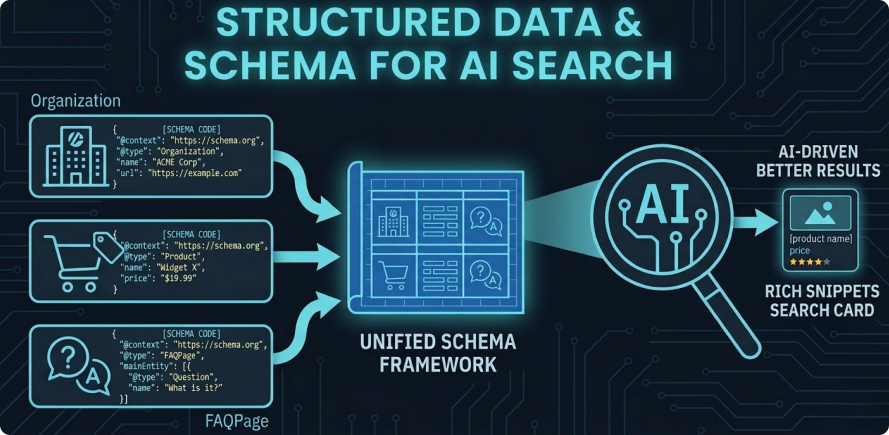
Structured data, specifically schema markup from Schema.org, has become the technical language that bridges the gap between human-readable content and machine-interpretable meaning. Where traditional SEO focused on keywords and links, AI search rewards clarity at the code level: pages that explicitly declare what each piece of information represents, how it relates to recognized entities, and where it comes from.
This guide explains how structured data fits into modern SEO, how AI search engines actually use it when deciding what to show users, and what you need to implement on your site so Google’s AI Overviews, ChatGPT, Perplexity, and similar systems choose your content as a source worth citing.
Why Structured Data Matters More in the AI Search Era
For years, schema markup was seen as an “optional SEO enhancement” a way to get star ratings, event cards, or recipe snippets in Google search results. In 2026, that framing is outdated.
AI search engines don’t just crawl and rank pages; they interpret, synthesize, and generate answers by pulling facts from multiple sources and assembling them into conversational responses. When an AI system evaluates hundreds of potential sources for a user query, structured data acts as a confidence signal: this page isn’t just claiming to be about something it’s machine-verifiably labeled as an article, product, recipe, local business, or FAQ, with all the key attributes explicitly defined.
Research on AI citations shows that pages with properly implemented structured data are significantly more likely to appear in Google AI Overviews, ChatGPT answers, and Perplexity citations than pages without it. One study tracking 6.8 million AI-generated answers found that 86% of citations came from brand-managed content, with structured first-party sites dominating over generic aggregators. Another controlled experiment demonstrated that only pages with complete Article, FAQ, and Breadcrumb schemas appeared in AI Overviews, while pages with incomplete or missing markup ranked in traditional results but were never selected by the AI layer.
The reason is simple: AI systems are trained to be careful about accuracy and attribution. Structured data reduces ambiguity. When a page explicitly marks a price as a price, a date as a publish date, and an author as a person entity with credentials, the AI doesn’t have to guess it can extract, verify, and cite with confidence.
How AI Search Engines Evaluate and Serve Your Content: The Real Process
To understand why schema matters, you need to see how AI search actually works under the hood.
Stage 1: Crawling and indexing (the foundation still matters)
Google’s AI Overviews, Gemini, and even ChatGPT with browsing all start with the same foundational layer: they rely on crawled, indexed content. Google has explicitly stated that AI Overviews use the same ranking systems and index as traditional Search, with an additional generative layer on top.
That means basic technical SEO still matters: your pages need to be crawlable, fast, mobile-friendly, and free of blocking directives. If a page isn’t in the index or is flagged as low-quality in traditional ranking, it will almost never be considered by the AI layer.
Stage 2: Content parsing and entity extraction
Once a page is crawled, AI systems try to understand what it’s about. This is where structured data becomes critical.
Modern AI search works by breaking content into logical “chunks” or “passages,” converting those into numerical representations called embeddings, and storing them in a knowledge base or vector database. During this process, the system looks for:
- Entities: recognizable people, places, organizations, products, or concepts that exist in the AI’s knowledge graph.
- Relationships: how those entities connect (e.g., “this person wrote this article,” “this product is sold by this organization”).
- Attributes: specific properties like prices, dates, addresses, ratings, or credentials.
Without schema, the AI has to infer all of this from unstructured text. A phone number might be a phone number, or it might be part of a story. A string of words like “Dr. Sarah Ahmed” might be a person, or just text. Schema removes that ambiguity by explicitly labeling each data point, making extraction faster, more accurate, and more reliable.
Stage 3: Relevance and authority scoring
After parsing content, AI systems evaluate which sources best match the user’s query and deserve to be cited.
This isn’t just keyword matching. AI search engines assess:
- Clarity: Is the content easy to interpret? Does it answer a specific question directly, or is it vague and wandering?
- Structure: Are headings semantic and logical? Are answers presented in clean, extractable blocks?
- Authority: Does the content come from a recognized entity? Is there author markup, organizational schema, and external validation through sameAs links?
- Freshness: Is the content current? Are dates, prices, and availability up to date?
- Trustworthiness: Does the page exhibit E-E-A-T signals? Real reviews, verifiable credentials, and consistent entity representation?
Structured data directly feeds into most of these signals. FAQ schema makes question-answer blocks obvious. Article schema with author and datePublished clarifies freshness and attribution. Organization schema with sameAs links reinforces that you’re a real, recognized brand, not a low-trust scraped site.
Stage 4: Answer generation and citation
Finally, the AI generates a response. If your page scored well on clarity, structure, authority, and relevance, it becomes one of the handful of sources the AI cites directly in the answer.
In Google AI Overviews, this means appearing as one of the linked sources underneath the summary. In ChatGPT or Perplexity, it means showing up in the “Sources” sidebar or inline references.
Importantly, AI systems don’t just “scrape” your schema and treat it as magic. Recent tests show that ChatGPT and Perplexity read structured data as part of the overall HTML, not through a special schema-only pipeline. That means schema works best when it accurately reflects visible on-page content and reinforces, rather than contradicts, what users see.
Schema Types That Matter Most for AI Search in 2026
Schema.org now includes over 800 types, but for AI search visibility, a smaller set delivers most of the value.
Article and BlogPosting schema
For any content page blog post, guide, news article Article or BlogPosting schema is foundational.
Key properties to include:
- headline: the title of the piece
- author: a Person entity with name, credentials, and ideally a sameAs link to LinkedIn or an author profile
- datePublished and dateModified: freshness signals AI systems rely on
- publisher: an Organization entity with logo and sameAs links
- image: a representative image for the content
This schema tells AI systems who wrote the content, when, and for which organization critical for E-E-A-T evaluation and citation confidence.
FAQPage and HowTo schema
FAQPage and HowTo are perfectly aligned with how AI search engines work: they present information in clean question-answer or step-by-step formats that generative models can directly lift.
A ITXITPRO analysis found that pages with FAQ schema were significantly more likely to appear in AI Overviews than pages without it, even when traditional rankings were similar. The reason is that FAQ schema explicitly structures the exact format AI needs: a question, followed by a complete, self-contained answer.
For service pages, product pages, and content hubs, adding a well-marked-up FAQ section at the bottom is one of the highest-ROI schema implementations you can do in 2026.
Organization and LocalBusiness schema
Entity SEO the practice of ensuring search engines and AI systems recognize your brand as a distinct entity in their knowledge graphs starts with Organization or LocalBusiness schema.
This schema should be implemented on your homepage, About page, and location pages, and should include:
- name: your legal business name
- logo: a clear, high-resolution logo image
- url: your canonical homepage
- sameAs: an array of URLs to your LinkedIn, Crunchbase, Wikipedia (if applicable), and other authoritative profiles
- For LocalBusiness: address, phone, opening hours, service area
The sameAs properties are especially important. They connect your site to external entities that AI systems already know and trust, reinforcing that you are who you say you are.
According to entity SEO research, content from entities recognized in knowledge graphs is 50% more likely to appear in featured snippets and AI-enhanced results.
Product and Review schema
For e-commerce and product-focused businesses, Product schema with complete offers, reviews, and ratings is critical for appearing in AI shopping assistants and AI Overviews for commercial queries.
Required properties include:
- name, image, description
- offers: with price, priceCurrency, availability
- aggregateRating: if you have real reviews, mark them up correctly
AI systems use this structured data to compare products, verify pricing, and generate shopping recommendations. Without it, you’re invisible to ChatGPT’s shopping features, Google’s AI shopping answers, and Perplexity’s product comparisons.
Breadcrumb schema
Breadcrumb schema helps AI systems understand site hierarchy and page relationships. In controlled tests, pages with Breadcrumb schema alongside Article and FAQ were the ones selected for AI Overviews, while pages missing breadcrumbs were not.
This is a simple implementation that clarifies where a page sits in your site structure, making it easier for AI to contextualize the information and determine its relevance to a query.
Common Structured Data Mistakes That Kill AI Visibility
A poorly implemented schema is often worse than no schema at all, because it signals to AI systems that your site is either sloppy or trying to manipulate results.
Marking up content that isn’t visible to users
One of the most common violations: adding reviews, FAQs, or product details in schema that don’t actually exist on the page. Google’s guidelines explicitly prohibit this, and while it may not trigger an algorithmic penalty, it can result in manual actions that remove your rich result eligibility entirely.
AI systems cross-check schema against visible content. If they don’t match, the page loses trust.
Using the wrong schema type
Marking up a blog post as a Product, or a product page as an Article, confuses both search engines and AI. Choose the most specific, accurate schema type for your content.
Missing required properties
Most schema types have required fields. If those are missing, the markup is incomplete and won’t be eligible for rich results or AI citations.
For example, Product schema requires name, image, and offers with price and availability. Without these, Google ignores the markup.
Always check Schema.org documentation and Google’s structured data guidelines for required vs. recommended properties.
Outdated or inaccurate data
Schema that claims a product is “in stock” when it’s not, or an event is “upcoming” when it already passed, damages trust. AI systems prioritize freshness and accuracy, so outdated schema actively hurts your chances of being cited.
Not validating before deploying
Implementing schema without testing is a recipe for failure. Use Google’s Rich Results Test, Schema Markup Validator, or tools like Sitebulb to validate your markup before it goes live.
How to Implement Structured Data for AI Search: A Practical Framework
For a UAE-based agency like ITX IT Pro, here’s a phased approach you can use internally or offer to clients.
Phase 1: Entity foundation (Week 1)
Start by establishing your brand as a recognized entity.
- Implement Organization schema on your homepage and About page with complete name, logo, url, and sameAs links to LinkedIn, Clutch, GoodFirms, and any other authoritative profiles.
- If you have physical locations, add LocalBusiness schema with correct NAP, opening hours, and service areas.
- Validate using Google’s Rich Results Test.
Phase 2: Content markup (Week 2-3)
Mark up your key content pages blog posts, guides, service pages with appropriate schema.
- Article or BlogPosting schema on all content pages, with author, datePublished, dateModified, and publisher.
- FAQPage schema on pages with Q&A sections (service pages, product pages, guides).
- Breadcrumb schema across your site to clarify hierarchy.
Phase 3: Product and service schema (if applicable)
If you sell products or services, mark them up.
- Product schema with complete offers, pricing, and reviews where applicable.
- Service schema for professional services with descriptions, provider info, and areas served.
Phase 4: Advanced entity linking (Ongoing)
Connect your internal entity graph and link to external knowledge graphs.
- Use consistent @id values for entities across your site (e.g., https://itxitpro.ae/#organization for your Organization entity).
- Link entities internally: Article author points to Person, Person worksFor points to Organization.
- Add sameAs properties that link to Wikipedia, Wikidata, or other trusted external sources where applicable.
Phase 5: Monitoring and iteration
Track whether your structured data is working.
- Use Google Search Console’s Enhancements reports to monitor valid vs. invalid schema and fix errors quickly.
- Manually test target queries in Google AI Overviews, ChatGPT (with browsing), and Perplexity to see if your site appears as a cited source.
- Audit quarterly: are dates current? Are products still in stock? Are opening hours accurate?
Measuring the Impact: What Success Looks Like
Traditional SEO metrics like rankings and organic traffic still matter, but in the AI search era you need to track new signals:
- AI inclusion rate: how often your site appears in AI Overviews, ChatGPT answers, or Perplexity citations for target queries.
- Rich result impressions: tracked in Google Search Console-pages with valid schema should show growth here.
- Click-through rate from rich results: properly marked-up pages often see 30-40% higher CTR than plain blue links.
- Entity recognition: does Google show a Knowledge Panel for your brand? Do you appear in related entity searches?
A Princeton University study on Generative Engine Optimization found that combining authoritative citations, statistics, and structured data produced up to 40% higher citation rates in AI-generated answers. The lesson: structured data amplifies other quality signals; it doesn’t replace them.
The Bigger Picture: Structured Data as the Language of AI-First SEO
Structured data in 2026 is not a “nice-to-have” or a tactical trick for rich snippets. It’s the foundational language that allows AI systems to confidently interpret, trust, and cite your content.
As AI search continues to evolve, we’ll likely see:
- Richer entity relationship markup, explicitly describing how people, organizations, and topics connect.
- LLM-specific schema types designed for AI retrieval and explainable outputs.
- Auto-generated structured data built directly into CMS platforms and AI content tools.
For businesses and agencies in competitive markets like the UAE, treating structured data as a core part of technical SEO not an afterthought will separate the brands that AI systems confidently cite from those that remain invisible in the new search landscape.





Frequently Asked Questions
Structured data is machine-readable code (usually JSON-LD schema markup) that explicitly labels what each piece of information on a page represents whether it’s a product, article, person, or FAQ. AI search engines like Google’s AI Overviews, ChatGPT, and Perplexity use this markup to confidently extract facts, verify claims, and decide which sources to cite. Without it, AI systems have to guess what your content means, which reduces your chances of being selected.
No. Structured data increases your eligibility and improves the AI’s ability to understand and trust your content, but it doesn’t guarantee citations. AI systems still evaluate traditional ranking factors, content quality, E-E-A-T, and relevance. Structured data works best when combined with strong content, clear writing, and solid technical SEO.
Start with Organization or LocalBusiness schema to establish your brand entity, then add Article/BlogPosting schema on content pages with author and date information. After that, FAQPage and Breadcrumb schema deliver strong ROI for AI visibility with relatively low implementation effort.
Use Google’s Rich Results Test and Schema Markup Validator to check for errors before you publish. After implementation, monitor Google Search Console’s Enhancements reports to see valid vs. invalid markup, and manually test target queries in AI search interfaces (Google AI Overviews, ChatGPT, Perplexity) to see if your site appears as a source.
Yes. Marking up content that isn’t visible to users like fake reviews or nonexistent FAQs can result in manual actions from Google that remove your rich result eligibility. AI systems also cross-check schema against visible content, so mismatches reduce trust and citation chances.
Recent tests suggest that ChatGPT and Perplexity read structured data as part of the overall HTML, not through a special schema-only process. That means schema still matters-it adds clarity and structured context but it works best when it accurately reflects your visible content, not as invisible metadata AI engines privilege separately.
Author Bio

Discover More Collaborative Development Initiatives
Stay ahead of the curve with expert tips, industry trends, and
actionable strategies—designed
to help your business thrive in the digital era.













 UAE
UAE
1801, API World Tower, SZR, Dubai,
United Arab Emirates
 India
India
Jaipur, Rajasthan
 USA
USA
Charlotte, United States
 CANADA
East Scarborough, Canada


